Quick answer
Short of it? In Ernakulam it’s nearly always subterranean termites, the ones everybody here calls white ants, coming up out of the soil and into your walls and woodwork. Still building? Good, then treat the soil before the foundation goes in and before the floor gets laid, and you’ve mostly solved it for years. Already moved in is a bit more work. We drill small holes along the bottom of each wall, push termiticide into the ground under the floor, then close them up again with white cement. Door frames or cupboards that are already chewed get injected separately, and where drilling’s not possible we put in bait stations. Whatever you do, don’t wait for the monsoon to “see what happens”.
Why termites love Kerala homes so much
Two things keep a termite happy: damp, and wood (or anything with cellulose in it; paper and cardboard count too). Kerala homes hand them both, twelve months a year.
Think about it. The air’s sticky most of the year, the rain hangs around for months, and the ground under your house barely gets a chance to dry. Now add what we build with. Teak doors, jackfruit wood doors, a rubber wood cot from some furniture shop in Perumbavoor, plywood wardrobes, and in the older tharavadus, wooden ceilings and rafters that grandfather put up sixty years ago. New flats aren’t spared either. Open any modular kitchen and it’s mostly particle board and ply.
The nasty bit is that you rarely see the damage. They eat from the inside and leave the outer skin of the wood almost untouched. People press a thumb into a door frame that looked perfectly fine, and it just gives way.
Signs you’ve got termites
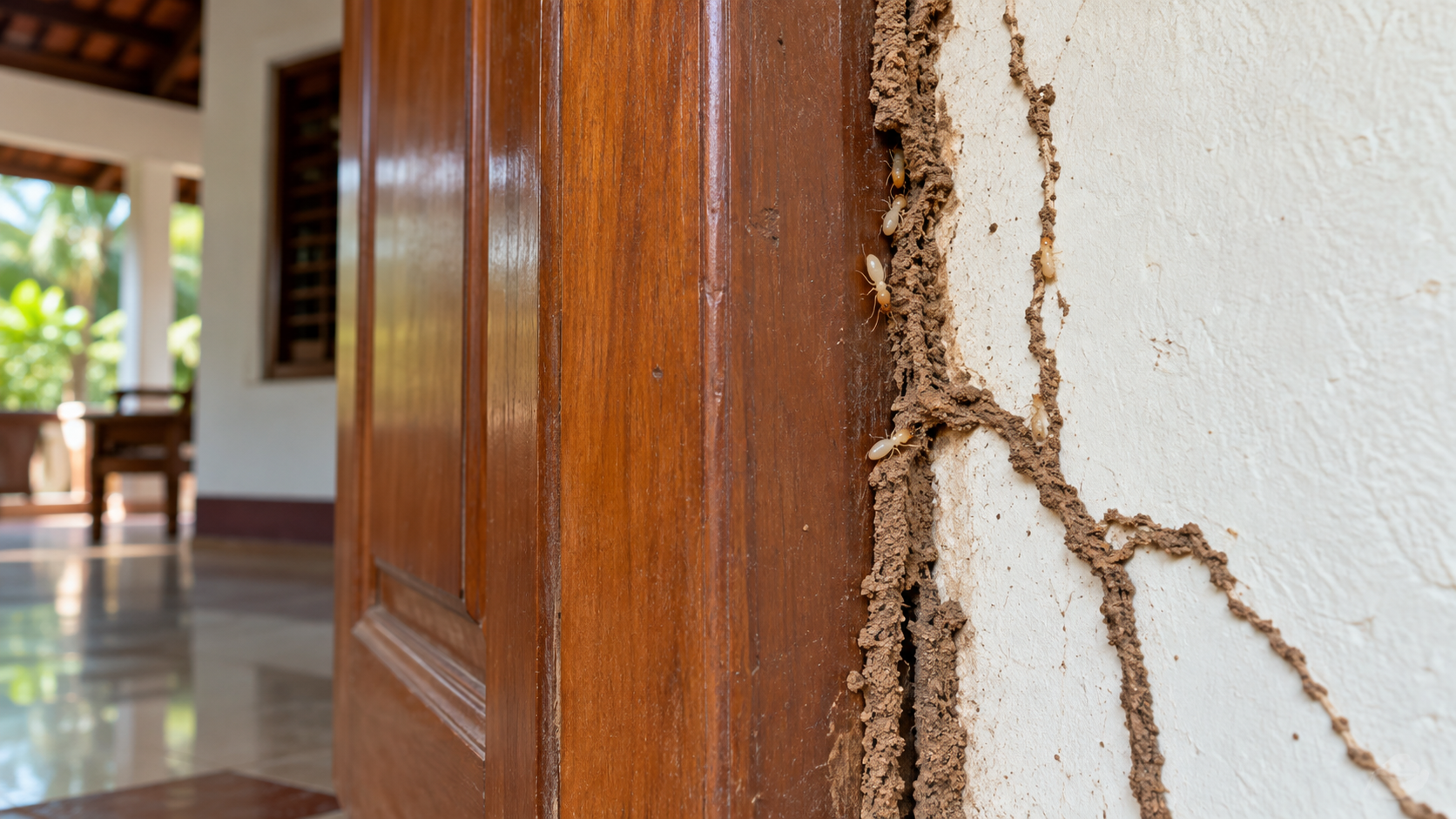
Start with mud tubes. They’re thin brown lines of dried mud, roughly the width of a pencil, climbing up a wall or running along the skirting, often hidden behind a cupboard you never move. Termites build these little covered roads so they don’t dry out on the way to your wood.
Next, go round tapping things. Door frames, the legs of the dining table, the back of the wardrobe. Solid wood gives a proper knock. Termite-eaten wood sounds dull, almost papery, like there’s nothing behind it (because there isn’t). After the first good rain, look at your window sills in the morning. A little heap of wings, all the same size, means a swarm flew out the night before and the colony isn’t far. Mud packed into furniture joints is another tell. So is paint that bubbles up or sags for no reason you can think of.
Seeing tiny dry pellets under a bit of wood, like coarse sand? Different culprit. That’s drywood termites, and we’ll get to them in a minute.
And please, don’t go breaking every mud tube and pouring kerosene on it. We know it feels like doing something. It just sends the termites off in new directions and makes the colony harder to find.
Subterranean or drywood? It matters
Almost every termite job we do in Ernakulam is subterranean. These live underground, build those mud tubes and come at the house from below, so that’s where we aim: the soil, and the line of the foundation.
Drywood termites don’t bother with soil at all. They move straight into the wood and stay there, so you’ll mostly find them in old furniture or wooden ceilings. For those, the termiticide goes directly into the wood.
Get it wrong and you’ll pay for a treatment that never touches the actual problem. So we always look first.
The treatment options, in plain words
If the house isn’t built yet, you’re in luck, because this is the cheapest time to do it properly. Pre-construction anti-termite treatment happens in stages as the building goes up: first the foundation trenches, then the plinth fill, then the soil just before the floor is laid. It’s all done to IS 6313, the Indian Standard for anti-termite work in buildings, and what you get at the end is a chemical layer under the entire structure.
If you’re already living there, it’s post-construction treatment. Our guys drill small holes where the floor meets the wall, spaced out around each room, and pump termiticide down so it soaks into the soil underneath. Afterwards the holes are filled with white cement. Nobody wants a floor that looks like a dartboard. We also treat outside, along the foundation and the soil around the house.
Wood that’s already being eaten needs its own attention. Door frames, cupboards, wooden fittings: we drill into them and inject directly. Spraying the surface looks busy but doesn’t reach anything.
Bait stations are what we use when drilling just isn’t an option, say a fully tiled courtyard or an old floor nobody wants touched. They go into the soil around the house. Termites eat the bait, carry it home and share it around. It takes longer, but it gets there.
About the chemicals, since every second customer asks. They’re all Central Insecticides Board approved, and our technicians change the dose depending on your soil and how the house is built. Not one size for every house.
What a PCCS termite visit looks like
The inspection is free, and it isn’t a quick glance. We walk the whole place, find where they’re active, follow the mud tubes and figure out how they’re getting in. You’re told plainly what needs doing and what it costs before anything starts. A normal 2BHK takes a few hours on treatment day. For a few days after, don’t scrub the drilled lines with strong floor cleaner. That’s about it. We come back later to check it’s holding.
Most families stay at home through the whole thing. We’ll just tell you which rooms to keep closed, and for how long.
Keeping them away afterwards
The treatment does its job far better once the damp is dealt with. So get that leaking pipe fixed, and the roof leak you’ve been ignoring since last monsoon. Firewood, old planks and cardboard boxes shouldn’t lean against the house. Garden soil and sand shouldn’t be heaped against the foundation. And push wooden furniture an inch or two away from any wall that tends to get damp.
Every few months, and definitely before and after the rains, take ten minutes and walk around looking for mud tubes. A colony caught early costs a lot less to sort out.
Questions people ask us
How long does termite treatment last?
Several years, when it’s done right. How many exactly depends on your soil, how wet it stays and how the house was built. Ask us about the warranty on your particular job.
Is it safe for my family?
It is. The chemical goes down into the soil under the floor and into the wood. It doesn’t hang around in the air. Just keep kids and pets off the treated areas for however long the technician says.
How much does termite treatment cost in Ernakulam?
Honestly, we can’t give a number without seeing the place. It depends on the area, how bad things are and which treatment fits. The inspection’s free, and the quote after it is fixed.
Should I treat before building?
Yes. Do it then. It’s much cheaper than treating later, and it protects the house right from the base.
Can termites come back?
They can. New construction or digging can break the barrier, and leaks that keep the soil wet don’t help. That’s why the occasional check matters.
Call us
Termites won’t stop by themselves, and every month you leave it they eat a bit more. Ring PCCS India on 0484 2354786, 9349550599 or 09633984599 and we’ll come for a free inspection. We work across Ernakulam, Kochi, Aluva, Kakkanad, Edappally and Thrippunithura, and also in Kottayam, Alappuzha and Kollam. There’s more on our termite control service page.